The 90-Day Restaurant Opening Checklist (Operator-Tested)
What the consulting deck leaves out. Written by an operator. Faceless by design.
Most restaurant opening checklists circulating online are worthless — not because the items are wrong, but because they are flat. A 200-item bullet list that treats "confirm POS training" with the same weight as "finalise liquor licence" is a document that creates the illusion of preparedness while concealing the dependency chain that actually determines whether the doors open on the date they are supposed to.
This dispatch sets out the operator-side 90-day critical path as we actually run it — the phasing, the gates, the compound-failure patterns, and the one audit that catches the three failures that kill most luxury independent openings in week 9.
It is written for operators opening a venue in the next 90 to 180 days. Independent fine dining, boutique hotel F&B, members' clubs, luxury beach clubs, celebrity-tier hybrid venues. If you are running your second or third site rollout, the multi-unit layer sits on top of this same path — same chapters, same gates, same compound-failure pattern.

Why most "opening checklists" miss the critical path entirely.
Open any top-ranked Google result for restaurant opening checklist and you get a flat document with the same three structural problems.
Problem one — the items are categorised by room, not by owner. "Dining room: chairs, tables, linen, lighting" lives in the same bucket as "Dining room: soundproofing, curtains, artwork." The GC and the designer and the sound engineer each own a different subset of that list, and their timelines are not coordinated. A bucket-by-room checklist cannot catch the fact that the sound engineer needs the linen final selection before signing off on the acoustic treatment — which is a real dependency that shows up at T-28 on every real opening and is invisible in every room-based checklist.
Problem two — severity is treated as the ranking axis. "Critical, important, nice-to-have" is an operator's retrospective labelling of what went wrong, not a pre-flight sequencing tool. At T-60 everything is "critical." Severity becomes useful only after the fact — at which point the opening has already either landed or slipped.
Problem three — compound dependency is not modelled. Three individual milestones each 90 percent likely to land on time produce, together, a 27 percent joint-failure probability. Most opening plans assume the milestones are independent and model each stream linearly. The divergence between the plan and reality shows up precisely at week 9, when the compound miss becomes unambiguous.
It is a sequenced dependency graph with named owners and weekly verification.
The five phases of the 90-day critical path.
The operator-side sequence we run is divided into five phases, each producing a defined set of exit artifacts before the next phase can begin.
T-90 to T-60 — Owner alignment and budget lockdown
Zero guest-facing output. The entire phase produces decision infrastructure: the signed owner-alignment memo (based on a nine-question interview), the budget with the change-control protocol explicitly written down, the decision matrix naming who decides the five fight-decisions (F&B creative, hero FF&E, senior hires, pricing, soft-open invites), and the three parallel tracks launched — FF&E shortlist, licensing tracker, staff hiring backward-plan.
This is the most-compressed phase in most openings. Operators who skip it end up running every fight-decision in the middle of a week-9 meltdown, without a prior alignment document to reference. The cost is almost always political rather than operational.
T-60 to T-42 — FF&E procurement and hero-piece tracking
Hero pieces — the one to three commissioned items that carry 40 to 70 percent of the guest's first-impression weight — enter the critical window. The vendor scoring framework runs weekly on five criteria: responsiveness under pressure, production transparency, slip honesty, shipping chain control, and redundancy posture. Vendors scoring 14 or below out of 25 trigger a backup-activation conversation.
The dated-photo protocol begins at T-56: every hero piece gets a weekly dated photograph from the production floor, taken that week, with a human in frame. "On track" in a status email stops being an acceptable artifact.
T-42 to T-21 — The week-9 zone
This is where most openings break. The 12-item pre-opening audit runs at T-49 minimum, re-runs weekly, and surfaces the three compound-failure patterns: a hero FF&E piece that was never on track, a licensing dependency chain nobody sequenced, and a senior hire who verbally accepted but never signed.
We cover this phase in detail in the free chapter of the full playbook.
T-21 to T-7 — Dry service and punchlist close-out
The 200-item punchlist is categorised by owner, not by room: GC scope, FF&E corrections, tech stack, operator/senior team, regulatory, owner sign-offs. Daily 07:30 standup begins at T-21 and does not become weekly until after T+14.
Two dry services run — T-10 and T-7 — with three invisible observers present at each (a senior operator from outside the project, a sensory specialist, and a civilian). The second dry service should produce 10-20 findings, not 40-80. If it produces similar volume to the first, the opening is at material risk and the owner conversation needs to reopen.
T-7 to T+0 — Opening night
The hour-by-hour run-of-show is drafted at T-14, circulated to all senior roles at T-10, rehearsed in the soft-open sequence, and held by the operator as the authoritative document on the day. Three rest-discipline rules matter disproportionately: no senior team member works past 22:00 on T-4, T-3, or T-2; a mandatory 6-hour sleep window on the night of T-2; and the operator personally identifies a deputy with sent-home authority for T-3 and T-2.
The final phase — T+0 to T+14 — is the post-launch stabilisation window that most playbooks skip entirely. Drift in the service standard begins between day 8 and day 12 and is caught only by a deliberate holding mechanism: daily 17:00 standups, the 3-table check every service, a plating photograph log, and the 21:00 room walk.
The audit you actually need.
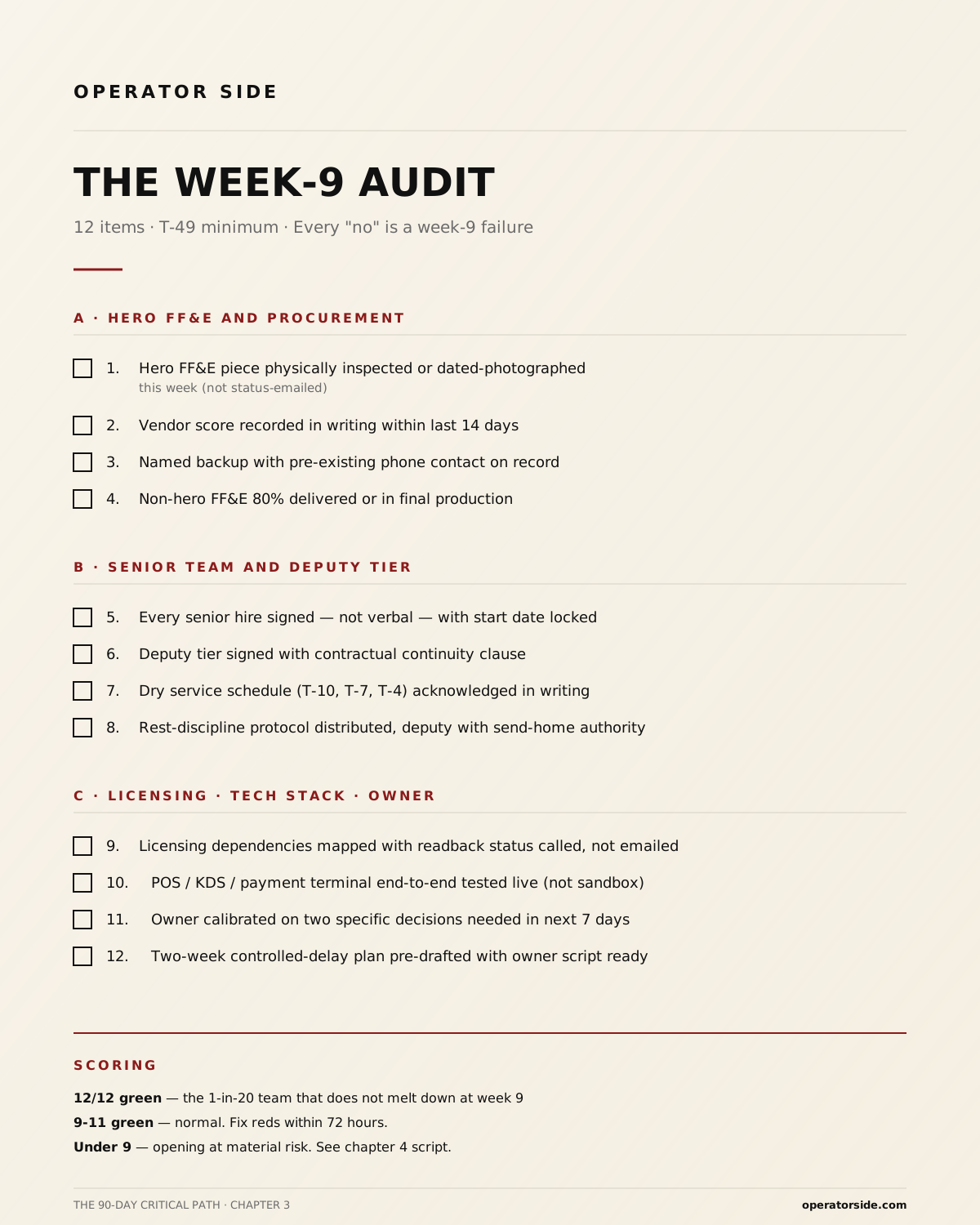
If you read nothing else in this dispatch, take this: at T-49, run a 12-item audit on the current state of the opening. Every "no" answer is a week-9 failure with your name on it. Every "no" is also fixable within 72 hours if caught at T-49 — and unfixable if caught at T-21.
The 12 items break into three groups.
Group A — The hero pieces and the FF&E chain
- Has every hero FF&E piece been physically inspected or dated-photographed this week (not status-emailed)?
- Is every hero-piece vendor scored against the five-criterion framework, with the score recorded in writing within the last 14 days?
- Does every hero piece have a named backup with a pre-existing phone call on record?
- Is the full non-hero FF&E list delivery-confirmed in writing, with at least 80 percent either delivered or in final production?
Group B — The senior team and the deputy tier
- Is every senior hire signed — not verbal — with start date contractually locked?
- Is the deputy tier for every senior role also signed, with contractual continuity if the senior pulls out?
- Has the pre-service rehearsal schedule (three dry services at T-10, T-7, T-4) been published and acknowledged in writing by the senior team?
- Is the rest-discipline protocol for T-4 / T-3 / T-2 distributed, with a named deputy holding sent-home authority for the operator?
Group C — Licensing, tech stack, and the owner
- Is every licensing dependency mapped on one page, with current readback status from the authority (called, not emailed)?
- Is the POS, KDS, payment terminal, and reservation system stack end-to-end tested with live transactions, not sandbox?
- Is the owner calibrated on two specific decisions that will need to happen between now and opening night?
- Is there a 2-week controlled-delay plan pre-drafted — not to be used, but drafted — with the owner conversation script ready?
9-11 green: normal. Fix the reds within 72 hours.
Under 9: the opening is at material risk.
What this reference costs vs. what the alternative costs.
A boutique pre-opening consulting engagement — the kind that ships a branded deck and a retainer and a senior partner who flies in twice — costs $40,000 to $80,000 for a single-site opening. Usually closer to $60,000 when travel passthrough is included.
For that, the owner gets a deck, weekly check-ins, an 80-page PDF that is 70 percent generic frameworks and 30 percent real content, a senior partner who is also running three other openings, and a contract that expires on opening day.
What the owner does not get: the thing the senior partner is actually Googling at 11pm when the client calls with a VVIP emergency.
That thing — the operator's real reference material — is in the full playbook we ship for $49. Not because we are generous. Because the math of digital distribution is different from the math of retainer billing, and we decided to pass that delta to the operator instead of protecting it.
Two next moves.
The free chapter — Week 9 Is Where It Breaks — goes deeper into the three compound failures and the T-49 audit protocol. 9 pages. No signup required.
The full 90-Day Critical Path playbook covers T-90 through T+14 with the 4-tab operational spreadsheet and 12 editable email + SOP templates. $49. 30-day operator refund, no questions.
FAQ
How long does it actually take to open a luxury restaurant?
A real luxury independent restaurant opening takes 9 to 14 months from first investor conversation to doors-open. The 90-day window this playbook covers is the final, highest-stakes segment of that timeline — from T-90 to T+0. Anyone quoting 90 days as the full build cycle is compressing an earlier 6-to-11-month architecture phase out of the conversation.
Why do so many luxury restaurant openings slip their launch date?
Because the failures that kill the date land in week 9 — the T-42 to T-21 window — and they compound. Three common week-9 failures: a hero FF&E piece that was never actually on track, a licensing dependency chain nobody sequenced, and a senior hire who verbally accepted but never signed. Any one is survivable. Two or three together inside a 72-hour window converts the opening into either a date slip or a rushed service-standard compromise.
Is a pre-opening consulting engagement worth the money?
For operators opening 3+ venues per year in different markets, yes. For single-site independent operators, the math rarely works — a boutique pre-opening engagement costs $40-80k and the deliverable is 70 percent generic frameworks and 30 percent real content. The operator-side reference material the senior partner is Googling at 11pm is the thing that actually moves the opening. That material is what the OPERATOR SIDE playbook ships for $49.
What does T-90 mean in a pre-opening schedule?
T-90 is the milestone marker indicating ninety days before the opening date. T-60 is sixty days before, T-42 is six weeks before, T-21 is three weeks before, T-7 is one week before, and T+0 is opening day itself. T+7 and T+14 mark the post-launch stabilisation windows. The convention makes sequencing unambiguous across multi-party project teams and is standard in luxury hospitality project management.
Can I use this checklist for a hotel F&B outlet launch?
Yes, with adjustments. Chapters on T-90 to T-60 (owner alignment), T-42 to T-21 (the week-9 zone), the owner conversation (chapter 4), and T+0 to T+14 (post-launch stabilisation) apply identically. Hotel-attached outlets skip portions of the T-60 to T-42 licensing sequence because the property-level licences already cover the outlet. Multi-unit operators use the framework as-is for sites 2-5 with the multi-unit consistency layer added.
Who writes these dispatches?
An operator with over a decade of experience opening and operating luxury independent venues across multiple regions. We do not name them. We do not name the venues. This is structural — the only way the content stays honest and unredacted is if no employer can identify the author. If faceless bothers you, this dispatch is not for you.